

Photodiodes for Microscopy and Nanopositioning Applications
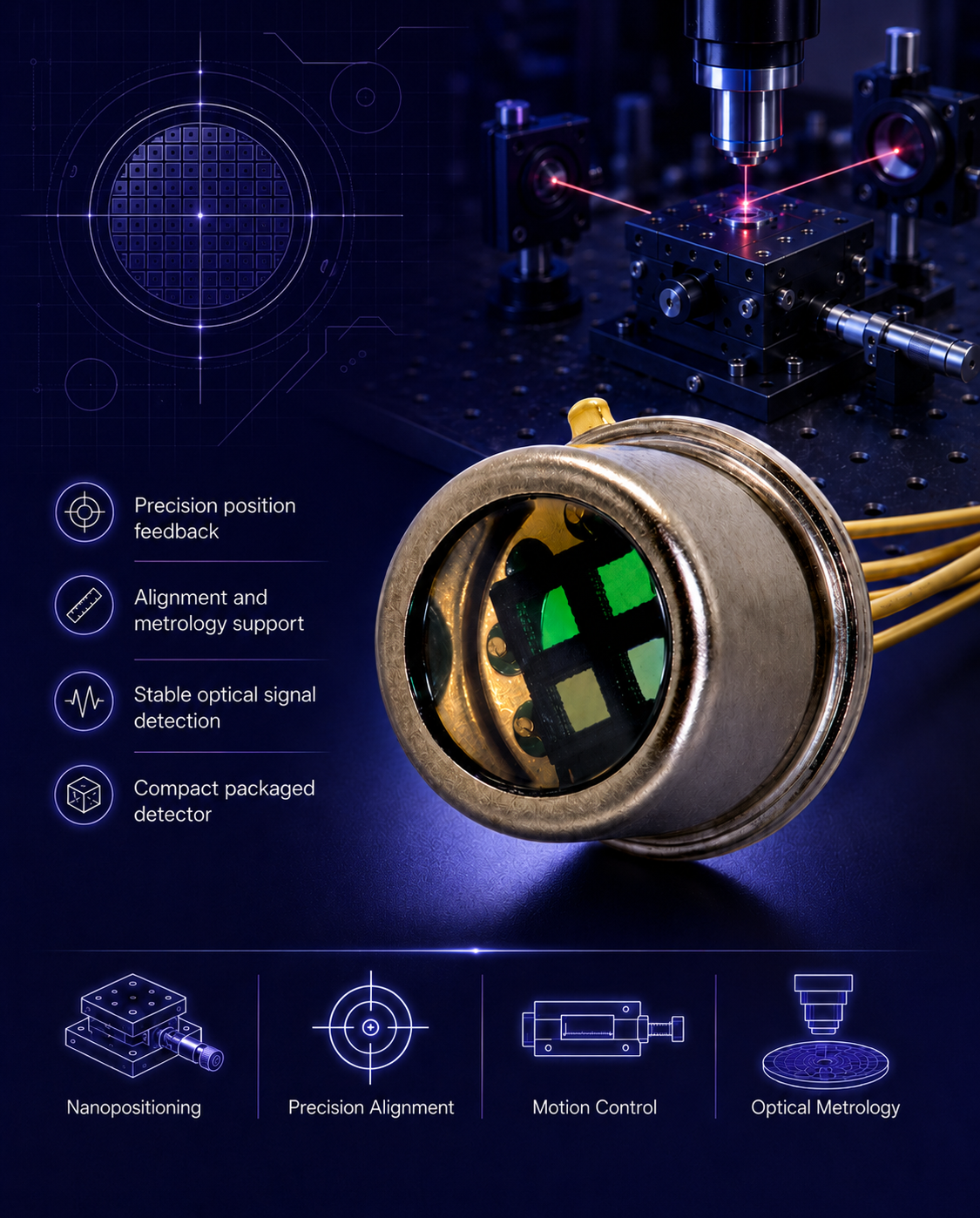
Microscopy and nanopositioning systems depend on detectors that can measure very small optical signals with stability and accuracy. In microscopy, the detector may need to capture low-light output from fluorescence, confocal, light-sheet, or super-resolution instruments. In nanopositioning, it may need to resolve tiny beam-spot shifts for AFM cantilever deflection, autofocus, beam centering, and optical alignment. In both cases, performance depends on more than peak responsivity: detector geometry, wavelength range, dark current, noise, package stability, and front-end electronics all matter.
Match the Detector to the Measurement
The right detector starts with the measurement type.
For intensity-based measurements such as fluorescence detection, brightfield monitoring, and confocal microscopy, a single-element photodiode is usually the best fit. Opto Diode’s blue-enhanced silicon photodiodes suit blue and short-wavelength visible fluorescence bands, while red-enhanced silicon photodiodes cover red and near-infrared emission. Both families operate across roughly 400–1000 nm.
For position-based measurements such as AFM deflection, autofocus, and beam centering, segmented photodiodes are preferred. A bi-cell detector supports single-axis focus tracking, while a quad-cell (four-quadrant) detector provides two-axis beam-position feedback.
Because bi-cell and quad-cell detectors place matched elements on a common substrate, they hold their relative response better than discrete photodiodes mounted separately — an advantage for centering accuracy and thermal stability.
Quad-Cell Detectors for AFM and Beam Centering
Four-quadrant photodiodes are the standard choice when an optical system needs to track beam movement across two axes. In an AFM beam-deflection setup, a laser reflects off the cantilever onto a segmented detector; as the cantilever moves, the beam shifts across the quadrants, and the differential signals feed the position loop.
A common substrate helps reduce quadrant mismatch, centering error, and thermal drift, which is why quadrant detectors are used for AFM, SPM, optical alignment, beam centering, and precision metrology. Opto Diode manufactures four-quadrant photodiodes — including the SXUVPS4 and SXUVPS4C quadrant designs and the AXUVPS7 quad detector — and can supply custom quadrant geometries matched to a specific beam profile and wavelength.
Bi-Cell Detectors for Autofocus and Single-Axis Tracking
Bi-cell photodiodes are used when the system needs feedback on one axis only. In an autofocus loop, the detector compares the outputs of two matched elements to produce a focus-error signal. That makes bi-cell detectors a good match for single-axis nulling, focus tracking, and alignment systems where long-term stability matters. Opto Diode’s red-enhanced ODD-3W-2 is one example of a bi-cell photodiode for visible and near-infrared work.
APDs for Low-Light Confocal and FLIM Detection
Confocal microscopy and FLIM often run in photon-starved conditions. When the optical signal is too weak for a standard PIN photodiode, an avalanche photodiode (APD) adds internal gain to lift the signal above the readout noise.
Opto Diode’s silicon APDs cover roughly 400–1100 nm for visible and near-infrared detection, while its InGaAs APD covers about 900–1700 nm for NIR and SWIR work such as spectroscopy and SWIR imaging.
Opto Diode Detector Families for Microscopy and Nanopositioning
The table below maps common measurement needs to a detector family and representative Opto Diode part numbers.
| Measurement need | Detector type | Example Opto Diode parts |
|---|---|---|
| Blue / short-wavelength fluorescence intensity | Blue-enhanced silicon photodiode (~400–1000 nm) | ODD-1B, ODD-1WB, ODD-5WB |
| Red / NIR fluorescence, laser power monitoring | Red-enhanced silicon photodiode (~400–1000 nm) | ODD-1, ODD-5W, ODD-12W, ODD-42W |
| Low-light confocal / FLIM (visible–NIR) | Silicon APD (~400–1100 nm) | ODD-APD-002, ODD-APD-003 |
| NIR / SWIR detection (900–1700 nm) | InGaAs APD | ODD-APD-001 |
| Single-axis autofocus / nulling | Bi-cell photodiode | ODD-3W-2 |
| Two-axis beam position (AFM, centering) | Four-quadrant photodiode | SXUVPS4, SXUVPS4C, AXUVPS7 |
Custom Detector Options
Some instruments need a detector that off-the-shelf parts cannot cover exactly. Opto Diode designs and fabricates detectors on-site at its Camarillo, California facility and can support custom active-area geometries, gap widths, quadrant and multi-element layouts, array configurations, and hermetic, windowless, or filter-integrated packages. These options help when an instrument has specific beam-profile, wavelength, resolution, package, or long-term stability requirements.
Selecting the Right Detector
Detector selection starts with the measurement. For microscopy, define the wavelength band, expected signal level, active area, noise floor, and bandwidth. For nanopositioning, define the beam profile, spot size, detector geometry, gap width, and stability requirements. Our guide to choosing a photodetector walks through these trade-offs in more detail.
Opto Diode’s applications engineering team can recommend a standard detector family or review a custom detector path for your system. Contact us for a quote — most are returned within one to two business days — or download the product catalog to compare families.
Frequently Asked Questions
Which photodiode is best for AFM beam-deflection sensing?
+
AFM cantilever deflection is a two-axis measurement, so a four-quadrant photodiode is the usual choice. Opto Diode makes four-quadrant designs such as the SXUVPS4 and SXUVPS4C and can build custom quadrant geometries. For single-axis autofocus or nulling, a bi-cell photodiode like the ODD-3W-2 is often enough.
When should I use an APD instead of a PIN photodiode?
+
Use an APD when the optical signal is too weak for a PIN photodiode to resolve above the readout noise, which is common in confocal microscopy and FLIM. The APD’s internal gain raises the signal. Choose a silicon APD (about 400–1100 nm) for visible and near-infrared light, or an InGaAs APD (about 900–1700 nm) for NIR and SWIR.
What is the difference between blue-enhanced and red-enhanced silicon photodiodes?
+
Both are single-element silicon photodiodes covering roughly 400–1000 nm, but their responsivity is tuned differently. Blue-enhanced devices are optimized for blue and short-wavelength visible light, making them a good fit for short-wavelength fluorescence, while red-enhanced devices favor red and near-infrared bands.
Can Opto Diode build a detector to custom specifications?
+
Yes. Opto Diode fabricates detectors in-house and can adjust active-area size and shape, gap width, quadrant or multi-element layout, and packaging, including hermetic, windowless, and filter-integrated options. Share your beam profile, wavelength, and stability requirements with the applications engineering team to start.
Reviewed and updated July 2026.
What's Latest


Get a Quotation Now
For any queries, please complete the form and we
will contact you within 48 hours